
Diagnosys is pleased to announce a major update to our Full-Field Stimulus Test (FST) module in Version 7. From improved threshold detection and refined quality scoring to built-in reference data and streamlined operator tools, this update is designed to make testing faster and easier to interpret.
Faster threshold detection
The purpose of the Full-Field Stimulus Test (FST) is to measure the threshold of light sensitivity or how dim a flash of light a person can reliably detect. The test begins with a very bright flash and gradually steps down in intensity using a staircase algorithm to find a threshold. The Auto-Locate feature allows you to pre-set the starting point in the software and proceed quickly through initial stimuli towards the threshold region.
Version 7 introduces a new refinement to this process: an updated Threshold Search Algorithm that uses the previously determined luminance threshold for a given color as the starting point for subsequent tests. This both shortens test time and helps preserve dark-adaptation by reducing exposure to bright flashes, improving both efficiency and data quality.
Simplified Interpretation
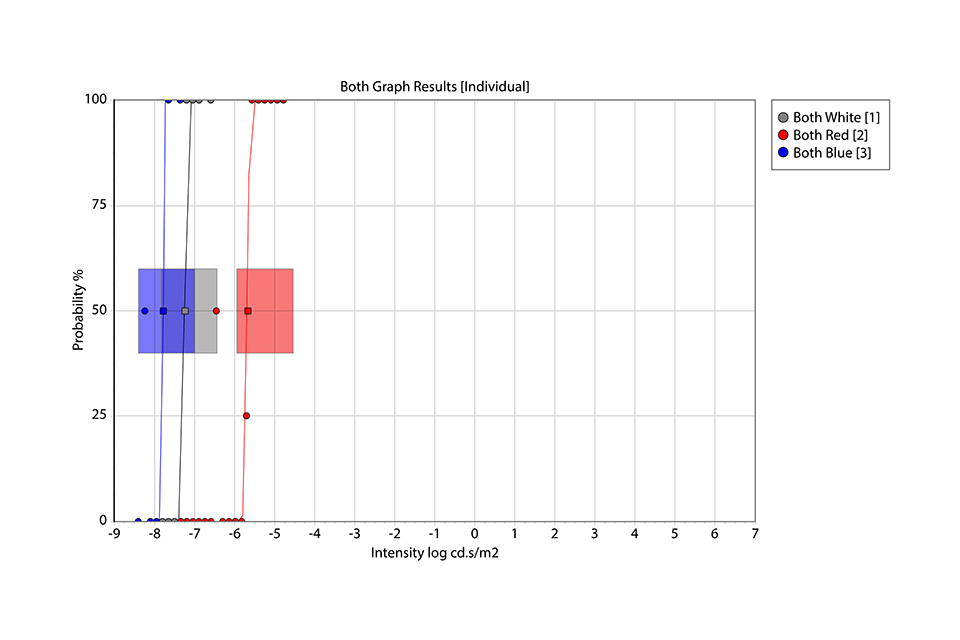
Version 7 introduces several updates that make it easier to interpret DiagnosysFST results. Built-in healthy subject reference data now appear directly in the marker table and as a dashed square outlining the normal range on the graph. This display can be toggled on or off as needed.
Diagnosys’ proprietary quality scoring algorithm, designed to assess the reliability of FST responses, has also been refined using larger datasets for more robust and consistent scoring.
Print readouts have been updated to include key test details such as stimulus color, background, and eye tested, making reports clearer and aligned with the latest ISCEV standard recommendations.
Haptic ‘buzz’ controller
The new FST controller is shaped like a familiar video game controller and has built-in haptic stimulation whose tactile ‘buzz’ can replace or complement the auditory ‘beep’ that indicates to a patient when they need to press a button. This feature makes testing easier for the deaf community and helps other patients maintain alertness throughout testing.
Operator enhancements
Version 7 makes FST easier for technicians to operate, thanks to a few thoughtful updates. The technician can now more easily select within the protocol the stimulus color and the eye to be tested. You can now easily keep track of the number of test runs completed when running multiple trials of the same eye or with the same stimulus color, by monitoring on screen prompts. A new progress bar displays real-time progress for each test, supporting both technician workflow and patient coaching.
Standardization of protocols
To ensure consistent test performance and maintain clinical standards, DiagnosysFST protocols are now standardized within the system. This change helps ensure reliable, comparable results across sites.
Altogether, these updates make DiagnosysFST not just faster but more versatile and easier to interpret.